Sell Silver
We buy silver in every form: jewellery, hallmarked items, cutlery, tableware, coins, ingots and broken oddments. Whether it is a single sterling bangle or a full canteen of Victorian flatware, we will weigh it, test it and make you a no obligation offer based on its silver content. We have been buying precious metals for over 35 years as a family owned and managed business, and we buy by post as well as across the counter in our seven high street stores.
Silver is worth considerably less per gram than gold, which changes how you should think about selling it. Weight matters far more, so a heavy item such as a tray, a teapot or a set of cutlery will usually be worth more than a drawer of light jewellery. It also means the £750 compensation cover included with every postal pack goes a long way with silver, and most customers can send everything they have in a single parcel without any concern. The one thing that catches people out is silver plate, which is extremely common and which we cannot buy, so it is worth checking your items before you post them.
Request Your Free PackSilver plate: please check before you send
Silver plate is a thin layer of silver over a base metal such as nickel or copper. It looks like solid silver, it tarnishes like solid silver, and a great deal of it was made, particularly cutlery and tea services. Unfortunately the silver content is so small that it cannot be recovered economically, so plated items have no scrap value and we are unable to buy them.
The marks below indicate plate rather than solid silver. If you find any of these, the item is plated:
- EPNS (electroplated nickel silver)
- EP, EPBM or A1
- Silver plate, plated, or Sheffield plate
- Nickel silver, German silver or alpacca, none of which contain any silver at all
Solid silver made in the UK carries a proper hallmark, usually including a lion passant, a walking lion in profile, along with a maker's mark, an assay office mark and a date letter. You may also see the number 925 stamped directly on the piece. If your item has a lion passant or a 925 stamp, it is solid sterling silver and we will buy it.
What silver we buy
If it is solid silver, we are interested, whatever condition it is in. Dents, tarnish, missing parts and damage do not stop us buying, because we are paying for the metal.
- Sterling silver jewellery, including broken chains, odd earrings and damaged rings
- Hallmarked cutlery, flatware and canteens
- Trays, teapots, tankards, bowls, cruets and photograph frames
- Candlesticks and candelabra
- Vesta cases, snuff boxes, card cases and small collectables
- Silver coins, including pre 1947 British coinage
- Silver Britannias, Maples, Eagles and other bullion coins
- Silver ingots and bars
- Continental and foreign silver marked 800, 830, 900 or 958
- Broken, bent and unidentifiable silver oddments
We also buy gold, platinum and palladium, so if your items are mixed you can send them all in the same pack and we will value each metal separately.
Silver purities explained
Silver is almost never pure, because pure silver is too soft for everyday use. It is alloyed with copper and other metals, and the standard tells you how much actual silver is present. We pay on the silver content, so the standard matters as much as the weight.
| Standard | Mark | Silver content | Typically found on |
|---|---|---|---|
| Fine silver | 999 | 99.9% | Bars, ingots and bullion coins |
| Britannia silver | 958 | 95.8% | Britannia coins and some antique wares |
| Sterling silver | 925 | 92.5% | Most UK jewellery, cutlery and tableware |
| Continental | 900 | 90.0% | European and American items |
| Continental | 830 | 83.0% | Scandinavian and German items |
| Continental | 800 | 80.0% | German, Italian and other European items |
You do not need to identify the standard yourself. We confirm the purity of every item using XRF testing, which reads the exact composition without damaging the piece. Send everything together and we will sort and test it for you.
Silver coins
British coinage contained real silver until 1946, and a great many of these coins are still sitting in tins and jars around the country. Coins dated 1919 or earlier are sterling standard at 92.5% silver. Coins dated between 1920 and 1946 were reduced to 50% silver. From 1947 onwards, British circulating coins contain no silver at all and are cupronickel, so a bag of post 1947 shillings and florins unfortunately has no scrap value.
The pre 1947 coins we buy include crowns, half crowns, florins, shillings, sixpences and threepences, along with Victorian and earlier issues. We also buy silver Britannias and other modern bullion coins. As with our gold coin buying, our offers are based on silver content rather than any collector premium, so if you believe you have genuinely rare dates or coins in exceptional condition, a specialist numismatic dealer may pay you more than we can.
Weighted and filled items
Some silver items are described as weighted, loaded or filled. Candlesticks are the most common example, along with some knife handles and small dressing table pieces. These have a solid silver outer shell but are filled internally with pitch, plaster or resin to give them stability, and that filling can account for most of the total weight.
We can still buy these items, but the offer reflects the silver in the shell rather than what the piece weighs on the scales. It is worth knowing this in advance, because a pair of candlesticks that feels reassuringly heavy may contain far less silver than you would expect. Our valuers will explain exactly what we have found when we make our offer.
How your silver is valued
We weigh your items on calibrated scales in grams and confirm the purity of each piece using XRF testing. Your offer is then calculated as a percentage of the live silver spot price applied to the actual silver content. Items are grouped by standard rather than weighed together, so a mixed parcel of 925 jewellery and 800 continental ware is assessed correctly rather than averaged.
Anything that is not silver is deducted before we calculate. That includes steel knife blades, gemstones, glass liners in cruets and salts, wooden or ivory handles, and the filling in weighted items. Current rates are shown on our Today's Prices page, and the rate we quote is the rate at the time we make the offer.
Please do not polish before sending
Tarnish is only a surface effect and it makes no difference at all to what your silver is worth to us. Polishing removes a small amount of metal each time, and on antique or hallmarked pieces heavy polishing can soften the marks and reduce what a specialist antique dealer would pay.
Send your items exactly as they are. We would much rather test an untouched piece and tell you honestly what we have found.
When silver is worth more than its scrap value
Most silver is worth its metal content, but not all of it. Pieces by recognised makers such as Georg Jensen, Liberty, Omar Ramsden or Paul Storr, early Georgian silver in good condition, and complete boxed canteens by well known firms can be worth substantially more intact than melted.
Our valuers look out for this. If we think something in your pack is worth more as an object than as metal, we will tell you rather than quietly weighing it in. You are under no obligation to accept our offer, and you will never lose out by asking us to look at something.
Sending silver by post
Every postal pack is sent using Royal Mail Special Delivery Guaranteed, which includes compensation cover of up to £750 per parcel. Because silver is worth far less per gram than gold, most silver parcels sit comfortably within that limit, and you can usually send everything in one go. Do bear in mind that Special Delivery has a weight limit, so a very large quantity of flatware or hollowware may need splitting across more than one pack, or may be easier to bring into a store.
If you believe your silver is worth more than £750, please request additional packs and split it, or buy additional cover at your Post Office at your own cost. Full details are on our Insurance Cover page. If the total value of what you sell us exceeds £1,000, you may be asked for photo ID and a recent proof of address before we release payment, so that we can meet our legal obligations. You also need to be 18 or over and have the right to sell the items you send.
Sell your silver today
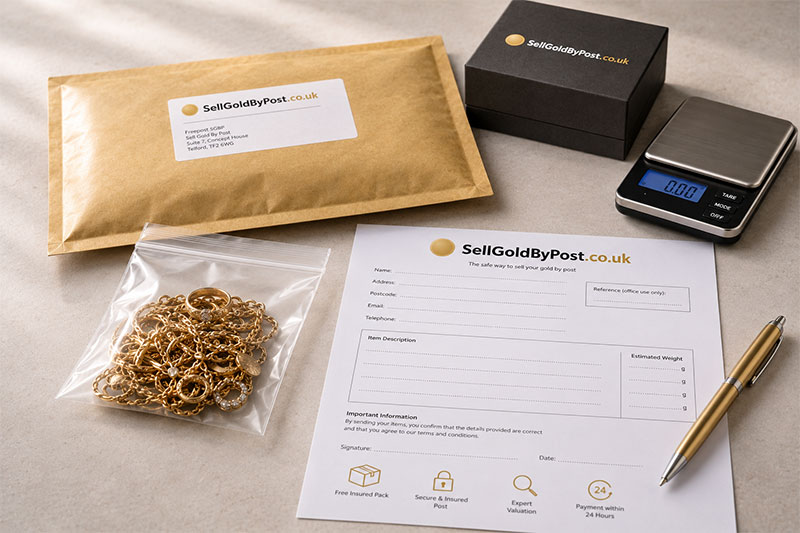
Request your free postal pack, send your silver in, and we will contact you with a no obligation offer once our valuers have assessed it. Accept and payment is sent by bank transfer, usually the same day and always by the end of the next working day. Decline and everything is returned to you free of charge, fully tracked, exactly as you sent it.